Bulletin archéologique et historique (1907)¶
A French Report on the Huguenot Colony in Berlin¶
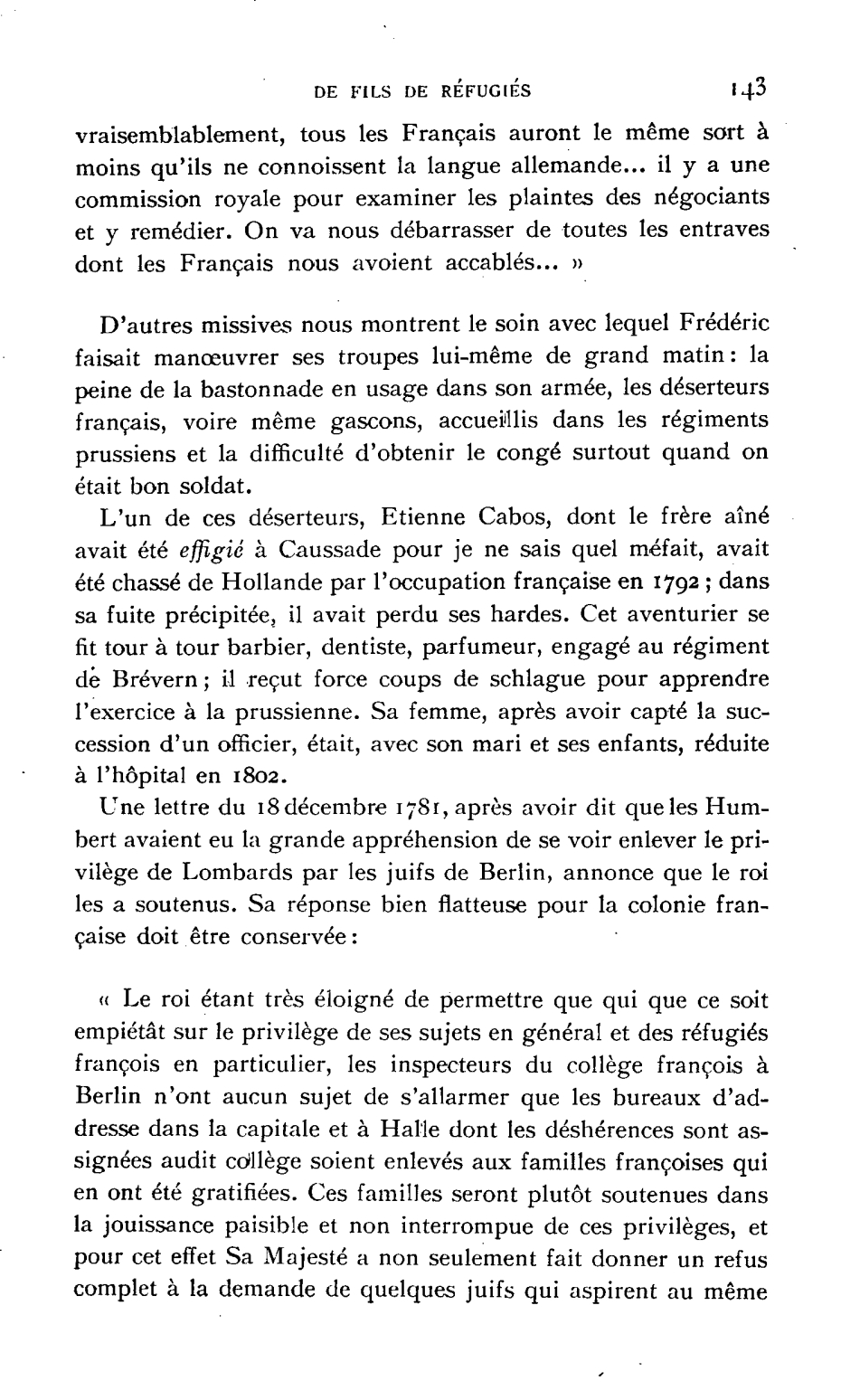
Page from the Bulletin archéologique et historique de la Société archéologique de Tarn-et-Garonne (1907), mentioning Etienne Cabos.
Document Information¶
| Field | Value |
|---|---|
| Document Type | Historical Journal |
| Title | Bulletin archéologique et historique de la Société archéologique de Tarn-et-Garonne |
| Volume | Tome 35 |
| Year | 1907 |
| Publisher | Société archéologique et historique de Tarn-et-Garonne |
| Press | Imp. et lith. Forestié, Montauban |
| Subject | Correspondence of French Huguenots in Berlin |
| Digitized by | Bibliothèque nationale de France |
| ARK Identifier | ark:/12148/bpt6k5663511j |
| Online Source | Gallica (BnF) |
| Local Copy | sources/Bulletin_archéologique_et_historique_de_[...]Société_archéologique_bpt6k5663511j.pdf |
About the Société archéologique de Tarn-et-Garonne
The Société archéologique et historique de Tarn-et-Garonne was founded in 1866 by Canon Ferdinand Pottier. Its first Bulletin appeared in 1869, and annually from 1877. The département of Tarn-et-Garonne encompasses the region around Montauban - only about 30 km from Caussade, Etienne Cabos's birthplace.
Content¶
The Bulletin contains excerpts from the correspondence of French Huguenots in Berlin, particularly from the Palmié and Humbert families. These letters provide a fascinating insight into the life of the French colony in Prussia in the late 18th century.
The Death of Frederick the Great (1786)¶
On August 19, 1786, Palmié reports to his cousin about the king's death:
"The sad news that has just put this country into mourning is the death of the great Frederick, who died on Wednesday at 2 o'clock in the morning; after suffering much, he died like a hero, and I doubt that his like will appear again on earth so soon. Despite the terrible suffering from dropsy, gout, and numerous other illnesses, he worked on state affairs until the end and only lost consciousness on Wednesday..."
The Dismissal of the French after 1786¶
Frederick's death brought great change to the French colony. From a letter dated November 21, 1786:
"Mr. de Launay, head of the administration, was dismissed, Director Grodait, with whom you traveled in 1766, was also dismissed; probably all the French will suffer the same fate, unless they master the German language... There is a royal commission examining the merchants' complaints and providing remedies. We will remove all the obstacles with which the French have burdened us..."
Etienne Cabos in the Bulletin¶
New Discoveries about Etienne Cabos
The Bulletin contains a direct mention of Etienne Cabos - with surprising details that appear in no other source!
The text reports on French and Gascon deserters who were accepted into Prussian regiments:
"One of these deserters, Etienne Cabos, whose older brother had been executed in Caussade for an offense unknown to me, had been driven from Holland by the French occupation forces in 1792; in his hasty flight he had lost his belongings.
This adventurer became successively a barber, dentist, perfumer, and entered the Regiment de Brévern; he received numerous blows to learn the Prussian art of drill.
His wife, who had inherited from an officer, was admitted to the hospital together with her husband and children in 1802."
Analysis of this Passage¶
This passage casts a completely new light on Etienne Cabos:
| Claim | Assessment | Note |
|---|---|---|
| "Deserter" | ⚠️ Unclear | Was Etienne a deserter from the French army? Or does this refer to his leaving Prussia? |
| Brother executed | ❓ Fourth brother? | Neither Jean (†1796) nor Pierre (1740, younger than Etienne). If true, there must have been a fourth, older brother! |
| 1792 driven from Holland | ✅ Confirmed | Matches the maintenance contract from April 1792, but "French occupation forces" is anachronistic - the French only came in 1795 |
| Lost belongings | ⚠️ Possible | Matches the family's financial distress |
| Barber, dentist, perfumer | ✅ Partially confirmed | The activity as a dentist is documented in the Hallische Anzeigen |
| Regiment de Brévern | ⚠️ Divergent | Other sources mention Regiment No. 8 (von Hacke) |
| Corporal punishment | ✅ Historically correct | The Prussian army was known for its harsh discipline |
| Wife inherited from officer | ❓ Not verified | No other source mentions this |
| 1802 in hospital | ⚠️ Partial | Etienne died in 1808 in the hospital; 1802 would be earlier |
Critical Assessment¶
The author of the Bulletin wrote in 1907 - about 100 years after the events. His information comes from family letters that may have contained rumors and hearsay. Some details (such as the "French occupation forces" in 1792) are chronologically incorrect.
Nevertheless, this source is valuable because it:
- Shows Etienne as a known figure in the Berlin Huguenot colony
- Confirms his varied occupations
- Provides hints of family tragedies in Caussade
- Describes the harsh living conditions in the Prussian army
Historical Context: The Rochette Affair (1761-1762)¶
Executions in Caussade during Etienne's Time
Although no direct connection to the Cabos family could be proven, there was a famous execution affair in Caussade precisely during Etienne's lifetime that shook the Protestant community.
The Arrest in Caussade¶
On September 14, 1761, the Protestant pastor François Rochette was arrested in Caussade. He had been holding illegal Reformed services "in the Desert" (underground) as an itinerant preacher in the region around Montauban. Etienne Cabos was 24 years old at this time and presumably still living in Caussade.
The next day, three Protestant nobles - the brothers Henri, Jean and Joachim de Grenier - tried to free the pastor and were also arrested.
The Execution in Toulouse¶
On February 19, 1762, all four were executed by the Parlement de Toulouse:
| Person | Age | Method of Execution |
|---|---|---|
| François Rochette (Pastor) | 26 | Hanged |
| Henri de Grenier | 44 | Beheaded |
| Jean de Grenier | 32 | Beheaded |
| Joachim de Grenier | 22 | Beheaded |
This execution was one of the last religious persecutions under the Ancien Régime. Just a few weeks later, on March 10, 1762, Jean Calas was executed in Toulouse - a case that gained European attention through Voltaire's intervention.
Possible Connection to the Bulletin's Claim¶
The claim about the "executed brother" could have various explanations:
- Confusion: The author of 1907 might have confused information about the Grenier brothers with the Cabos family
- "Brother in faith": "Brother" could metaphorically mean a brother in faith of the Protestant community
- Actual Cabos: There could have been an unknown Cabos who was executed during this turbulent time
- Reason for flight: The persecutions could have motivated Etienne to flee to Prussia - even without direct family connection
Research Needed
A search in the Archives du Parlement de Toulouse (sacs à procès) and the Archives départementales de Tarn-et-Garonne could provide further clues.
Sources:
Frederick the Great and the French Colony¶
The Bulletin also contains a remarkable letter from Frederick the Great dated 1781, in which he defends the privileges of the French colony:
"Since the King would in no way allow anyone to infringe upon the privileges of his subjects in general and of the French refugees in particular [...] His Majesty has not only completely rejected the request of some Jews who seek the same privilege, but has also ordered the Director General of his Finances that this privilege must never be taken away from the French colony..."
Potsdam, October 5, 1781.
Written in his own hand: "M. P. You have nothing to fear from me, if I can do you a service, yes, but never harm you." FRÉDÉRIC.
This shows how much Frederick valued the Huguenots - an attitude that changed after his death in 1786.
Significance for Family History¶
This document is one of the few external sources that mention Etienne Cabos by name. It completes the picture of a man who:
- Possibly had a tragic family history in France
- Practiced various professions to survive
- Experienced the hardships of the Prussian army
- Despite all adversities, founded and maintained a family
The discovery of the brothers Jean Cabos (†1796 Caussade) and Pierre Cabos (b. 1740, younger than Etienne) shows that neither of them was the executed "older brother." If the claim in the Bulletin is correct, there must have been a fourth, older brother who was born before 1737. This question remains a fascinating puzzle for further research in the church records of Caussade.